Washington has moved toward commercial diplomacy and critical minerals. The harder test is whether its trade policy can support the long-term relationships that strategy requires.
Editor’s note: This article was originally published in November 2023 and was substantially rewritten in August 2026 to reflect changes in US policy toward Africa.
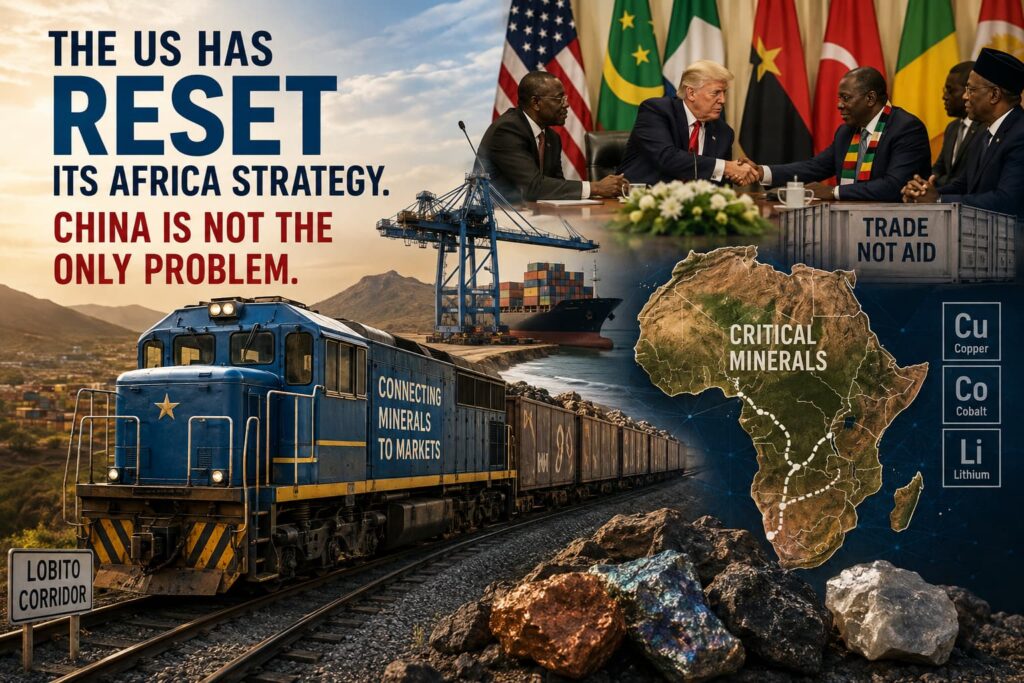
The Reset Already Happened
In July 2025, five African presidents sat down with Donald Trump at the White House. I looked at the photographs later and noticed something more interesting than the formal setting: the meeting reflected a Washington that increasingly wanted to talk about transactions rather than assistance. The language around Africa had changed.
When I first wrote about this subject in November 2023, I asked whether the United States needed to reset its Africa strategy. I would not frame the question that way now. Washington has already changed the hierarchy of its interests, putting commercial diplomacy much closer to the centre while reducing the place once occupied by traditional development assistance.
The Trump administration described the approach in unusually direct terms in 2025. Senior State Department official Troy Fitrell called it a shift toward “trade, not aid” and said American ambassadors in Africa would increasingly be judged by the commercial deals they helped produce. During Trump’s first 100 days, US officials said American envoys had facilitated 33 agreements worth more than $6 billion.
I do not see this merely as an aid cut dressed in commercial language. It reflects a harder definition of influence, one in which Washington expects diplomatic relationships to generate measurable economic returns. But the change contains more continuity than the slogan suggests.
Trump Did Not Invent the Commercial Turn
The American move toward business engagement in Africa did not begin in January 2025. Under Joe Biden, Secretary of State Antony Blinken was already calling for more commercial diplomacy missions and stronger embassy involvement in finding investment opportunities. At the 2022 US-Africa Business Forum, Biden announced more than $15 billion in trade and investment commitments.
By 2024, the Biden administration said Prosper Africa had helped close 1,695 deals worth $63.5 billion in 41 African countries since January 2021. During just the final six months covered by that update, the US government said it had facilitated 401 deals worth another $32.5 billion. Those figures make it difficult to argue that commercial diplomacy suddenly appeared with Trump.
The difference lies elsewhere. Biden tried to expand trade while keeping development assistance and broader political engagement inside the same Africa policy. Trump has elevated commercial transactions more aggressively and tied diplomatic performance more openly to business results.
That distinction matters. A gradual expansion of commercial diplomacy is one thing; reorganising the relationship around transactions is another. I see the Trump reset less as the invention of a new instrument than as a decision to give an existing instrument greater weight.
The Mineral Map Explains Why Washington Is in a Hurry
Critical minerals make the urgency easier to understand. Africa holds an estimated 30 percent of the world’s proven reserves of critical minerals, while 35 African countries produce at least one such mineral. Yet the continent captures only about 10 percent of global critical-mineral revenues.
That gap sits at the centre of two different strategic calculations. Washington wants supply chains that reduce dependence on geopolitical rivals, particularly where China dominates processing. African governments increasingly want to capture more value before minerals leave their territory.
The Democratic Republic of Congo makes the stakes obvious. It remains the world’s dominant producer of cobalt, a metal used across modern industrial supply chains. American policymakers therefore face a problem that cannot be solved simply by buying more ore: access to a mine means much less if refining and downstream processing remain concentrated elsewhere.
The Lobito Corridor is Washington’s most visible attempt to change part of that geography. The US International Development Finance Corporation committed $553 million to the Lobito Atlantic Railway, covering roughly 1,300 kilometres of track between Angola’s Atlantic coast and the mineral trade coming from the DRC. DFC expects the upgraded railway to increase transport capacity from about 0.4 million metric tons a year to 4.6 million.
I find the political continuity behind Lobito almost as important as the railway itself. The project gained prominence under Biden, yet the Trump administration retained it because its strategic logic survives party politics. In April 2026, the Africa Finance Corporation was seeking between $3 billion and $5 billion from African and international lenders for the wider corridor, with completion targeted for 2030.
China Has Already Built the Commercial Depth
Calling Africa another battlefield in a US-China rivalry can hide the real imbalance. Washington is trying to expand commercial influence in places where Chinese companies have spent years building relationships around physical assets. A new American policy announcement does not erase that accumulated position.
China’s economic reach also continues to grow. Chinese exports to Africa increased by 25.8 percent in 2025 even as exports to the United States fell by 20 percent, according to Chinese customs data reported by Reuters. Beijing’s wider diversification away from the US market is therefore strengthening the same African commercial networks that Washington now wants to challenge.
Processing capacity presents an even more difficult problem. A government can finance a railway faster than it can recreate an industrial ecosystem that took years to build, especially when Chinese firms already occupy important positions in mineral refining. Washington can improve access to African resources, but access alone does not create an independent supply chain.
This is where I think the phrase “competition with China” becomes too simple. America does not need merely to persuade African governments to prefer Washington. It must offer investments that survive changes in administrations and still make commercial sense once the political attention shifts somewhere else.
Washington Is Undermining Its Own Commercial Argument
The clearest contradiction appears in trade policy. Washington tells African governments that the relationship should move from assistance toward commerce, yet one of the principal frameworks for African access to the US market has spent the past year surrounded by uncertainty. The African Growth and Opportunity Act expired in September 2025 before Congress restored its benefits retroactively.
The current extension lasts only until December 2026. Congress may renew AGOA again, but an investor deciding whether to build a factory needs a horizon measured in years rather than months. A temporary extension cannot provide that confidence.
Tariffs made the contradiction sharper. According to the IMF, the effective US tariff rate on imports from sub-Saharan Africa stood near zero at the end of 2024, climbed above 12 percent by October 2025, and then fell to 8.5 percent by late February 2026. The decline followed the retroactive AGOA extension and a US Supreme Court ruling that invalidated tariffs imposed under the International Emergency Economic Powers Act.
Those numbers matter more than any slogan about trade replacing aid. A company may appreciate an American ambassador helping it find a deal, but capital still looks at tariff exposure and legal stability before committing money. Washington cannot easily build long-term commercial influence while leaving the rules of market access open to repeated political shocks.
Security creates another complication. The United States completed its withdrawal from Niger in 2024, losing access to a country that had served as an important counterterrorism platform in the Sahel. American forces have continued operations elsewhere, but the Niger withdrawal showed that security relationships can weaken even while Washington tries to deepen economic ones.
I therefore find “trade, not aid” useful as a description of political direction but inadequate as a complete Africa strategy. Investment depends on functioning states and predictable rules. Where violence damages state authority, commerce cannot simply replace the security question.
African Governments Have More Leverage Than the Old Debate Assumed
The original 2023 debate contained another weakness. It treated Africa largely as the object of American strategy, as though Washington only had to choose the correct policy and African governments would respond accordingly. The mineral contest makes that assumption increasingly difficult to sustain.
African governments know that the United States wants alternatives to Chinese-controlled supply chains. They also know Beijing has reasons to defend the commercial position it already possesses. That competition creates bargaining space that did not exist in the same form when Western governments could discuss access to African resources mainly on their own terms.
The revenue figures explain why African demands are changing. A continent estimated to hold around 30 percent of global critical-mineral reserves receives only about 10 percent of the associated global revenues. Brookings argues that growing strategic competition gives African states room to press harder for local value creation and better infrastructure rather than accepting another extract-and-export cycle.
From Karachi, I recognise the pattern. Countries outside the major-power core often discover that rivalry among larger states creates bargaining opportunities, but the opportunity disappears quickly if domestic institutions cannot convert foreign interest into durable economic value. Africa’s growing leverage is real; the final distribution of that value remains unsettled.
I asked in 2023 whether Washington needed to reset its Africa strategy. By August 2026, I think that question has been answered: commercial diplomacy now carries greater weight, while access to critical minerals gives the relationship a harder strategic edge. The unresolved question sits somewhere along the railway from the Congolese mineral belt to the Atlantic coast. The trains are already moving.