Britain did not invent Zionism, but its imperial machinery gave the Jewish national project a status that Palestinian Arabs did not receive on equal terms.
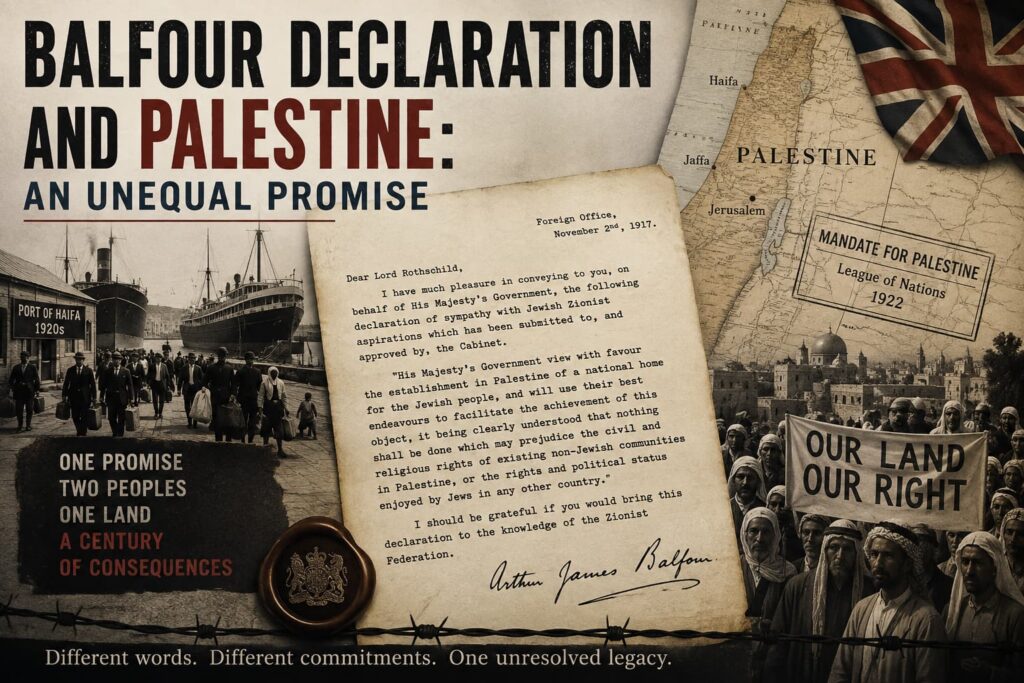
Balfour Declaration and Palestine: An Unequal Promise
Britain did not invent Zionism, but its imperial machinery gave the Jewish national project a status that Palestinian Arabs did not receive on equal terms.
I opened the Balfour letter again on a screen in Karachi and stopped at two phrases. Balfour Declaration and Palestine usually brings attention to “a national home for the Jewish people.” I found the second description more revealing: Palestine’s Arab majority entered the same sentence as the “existing non-Jewish communities.” Britain had already chosen two different political vocabularies before it had completed its conquest of the country.
The distinction was small on paper. Its constitutional weight was not. Britain promised support for a Jewish national home, while its protection for the other inhabitants covered civil and religious rights. The House of Commons Library confirms the declaration’s wording and its date, 2 November 1917.
Balfour Declaration and Palestine in One Sentence
Arthur Balfour sent the declaration to Lord Rothschild for transmission to the Zionist Federation. Palestinian Arabs did not appear by name. Britain described them through what they were not, even though they formed the large majority of the population. The letter also protected the political status of Jews in other countries, but it offered no equivalent statement of Arab national purpose inside Palestine.
I do not read that wording as proof that Britain had already decided to create a Jewish state. Balfour himself told Parliament on 14 November 1917 that the future constitution of Palestine could not yet be forecast. Five years later, the British government stated that it did not intend to turn Palestine as a whole into a Jewish national home.
The narrower asymmetry still matters. In Balfour itself, Jewish nationhood received an affirmative political commitment. Palestinian Arabs received a protective clause rather than an equivalent national undertaking. Civil protection can restrain a government; it does not answer who should control immigration or determine the constitutional future of a territory.
The Mandate Turned a Promise into Machinery
Diplomatic language became administrative law in 1922. The League of Nations Mandate made Britain responsible for creating conditions that would secure the Jewish national home while also developing self-governing institutions. Article 4 gave a Jewish agency formal status as a public body that could advise and cooperate with the administration. The Mandate gave no Arab body an equivalent Article 4 status.
Article 6 carried the commitment into immigration policy. Britain had to facilitate Jewish immigration under suitable conditions and encourage close Jewish settlement on the land, subject to protection for other sections of the population. Article 7 required provisions that facilitated Palestinian citizenship for Jews who took permanent residence. Those were operative obligations, not ceremonial language.
| Instrument | What it did |
|---|---|
| Balfour Declaration, 1917 | Backed a Jewish national home while safeguarding civil and religious rights of non-Jewish communities |
| Mandate Article 4 | Recognised a Jewish agency as a public body |
| Mandate Article 6 | Required facilitation of Jewish immigration under suitable conditions |
| Mandate Article 7 | Required a route that facilitated citizenship for permanently resident Jews |
The Mandate also contained limits that deserve equal attention. Article 2 required Britain to safeguard civil and religious rights for all inhabitants, while Article 3 called for local autonomy where circumstances permitted. British policy therefore did not treat Palestinian Arabs as people without rights. The deeper problem concerned the difference between protected rights and recognised national agency.
The Census Put People Beside the Legal Text
Numbers make the constitutional problem harder to hide. A later League of Nations table, excluding British forces and their families, put Palestine’s 1922 population at 752,048. Muslims numbered 589,177, while Jews numbered 83,790. Christians accounted for 71,464.
| 1922 category | Population | Share |
|---|---|---|
| Muslims | 589,177 | 78.34% |
| Jews | 83,790 | 11.14% |
| Christians | 71,464 | 9.50% |
| Others | 7,617 | 1.01% |
Note: The original census return counted 757,182 people when military personnel and some other categories were included. Later League tables used a narrower scope and reported 752,048.
Religious categories do not map perfectly onto nationality, so the census cannot function as a clean nationalist ledger. The scale still matters. A Jewish population of roughly one in nine lived under a Mandate that explicitly supported development of a Jewish national home. The much larger Arab population had civic safeguards and promises of self-government, but no matching international commitment to an Arab national home.
A political contradiction followed. Full majority rule could allow Arab representatives to restrict immigration, while unrestricted majority control could obstruct a policy Britain had pledged to advance. Britain could protect the national-home commitment, or it could permit ordinary majority power over the policy that sustained it. Holding both positions became increasingly difficult.
From Karachi, I Read the Verbs
My work in HBL’s Treasury SWIFT section has trained me to notice operative language. A code is not decoration. One field can change how an instruction moves through a banking chain, even when the message looks routine to someone outside the system. I bring the same habit to imperial paperwork, although the political stakes and legal setting are obviously different.
The Mandate’s verbs deserve attention for that reason. Britain would “facilitate” Jewish immigration. An appropriate Jewish agency would be “recognised” as a public body. Palestinian Arabs had political organisations of their own, but the Mandate did not grant one of them the same Article 4 position.
Karachi also makes imperial categories feel less remote to me. South Asia still lives with boundaries and institutions inherited from British rule, although Palestine followed its own historical path. I do not need to claim that the two cases were identical. The regional vantage simply makes me suspicious of constitutional formulas drafted in London and administered among populations that had limited power over the original bargain.
Britain Tried to Limit Its Own Promise
The 1922 Churchill White Paper complicates any simple accusation that Britain planned a wholly Jewish Palestine. London rejected that interpretation and said it had never intended the disappearance or subordination of the Arab population. The document defined the Jewish national home as development of the existing Jewish community rather than imposition of Jewish nationality on all inhabitants.
That qualification matters because a serious argument must distinguish a national home from an explicit promise of statehood. Britain maintained the distinction for years. The Mandate nevertheless internationally guaranteed the national-home project and supplied administrative mechanisms that helped it develop. London therefore limited the destination while preserving much of the machinery.
The Palestinian Arab objection survived the clarification. Britain had undertaken to advance a national project without first obtaining the majority population’s consent to that project. Safeguards for property or religion could not settle who should decide future immigration. Nor could they determine how political sovereignty would eventually pass from the Mandatory power.
A British letter preserved in U.S. diplomatic records exposes the tension with unusual clarity. In March 1922, the Colonial Office told the Palestine Arab Delegation that Britain could not allow a constitutional arrangement to develop if it made the Balfour commitment impracticable. Representative government therefore faced a built-in limit when majority preferences threatened an earlier imperial pledge.
The 1939 Reversal Showed How Deep the Conflict Ran
By 1939, Britain had changed direction. The MacDonald White Paper said earlier inquiries had identified ambiguity around the national-home policy as a major cause of hostility. London now declared that turning Palestine into a Jewish state against the will of the Arab population could not have been the intention of the Mandate. It also moved toward tighter immigration limits.
The reversal did not erase the earlier legal structure. The Permanent Mandates Commission examined the new policy and found that it departed from the interpretation previously placed on the Mandate. Four commissioners could not say the White Paper conformed to the Mandate; three believed changed circumstances might justify the policy if the League Council did not oppose it. Britain had reached a point where retreat from one commitment created another legal dispute.
Jewish opposition had an obvious basis. Nazi persecution had made refuge increasingly urgent, while Britain now constrained immigration into the territory where it had spent years encouraging a national home. Palestinian Arabs approached the same policy from the opposite direction: London had taken two decades to place greater weight on majority consent. Each side could therefore describe British policy as betrayal, but for very different reasons.
The Question Britain Never Settled
I return to Balfour’s sentence because its imbalance survives every later qualification. Britain did not invent Jewish attachment to Palestine, and Zionism existed before British rule. The Mandate itself recognised the historical connection of the Jewish people with Palestine. Any account that treats Jews as an imperial population invented in London distorts the record.
Nor can I reduce Palestinian opposition to hostility toward Jewish immigration. A majority population lived under a government committed to advancing another national movement while restricting the point at which majority rule could obstruct that commitment. Bureaucratic asymmetry existed long before the later battlefield. The political question concerned consent as much as communal coexistence.
The original document still leaves me with an uncomfortable constitutional problem. Britain named one people’s national project and built machinery around it, while the majority population never received an equivalent national undertaking in the Mandate. Civil safeguards mattered, but they did not decide sovereignty. Could an empire promise one people a national future in an inhabited country before it had defined an equal political future for the people already forming its majority?
- AI Transparency Statement: “This analysis was drafted under editorial direction with AI technical assistance, then verified and edited by Munaeem Jamal.”