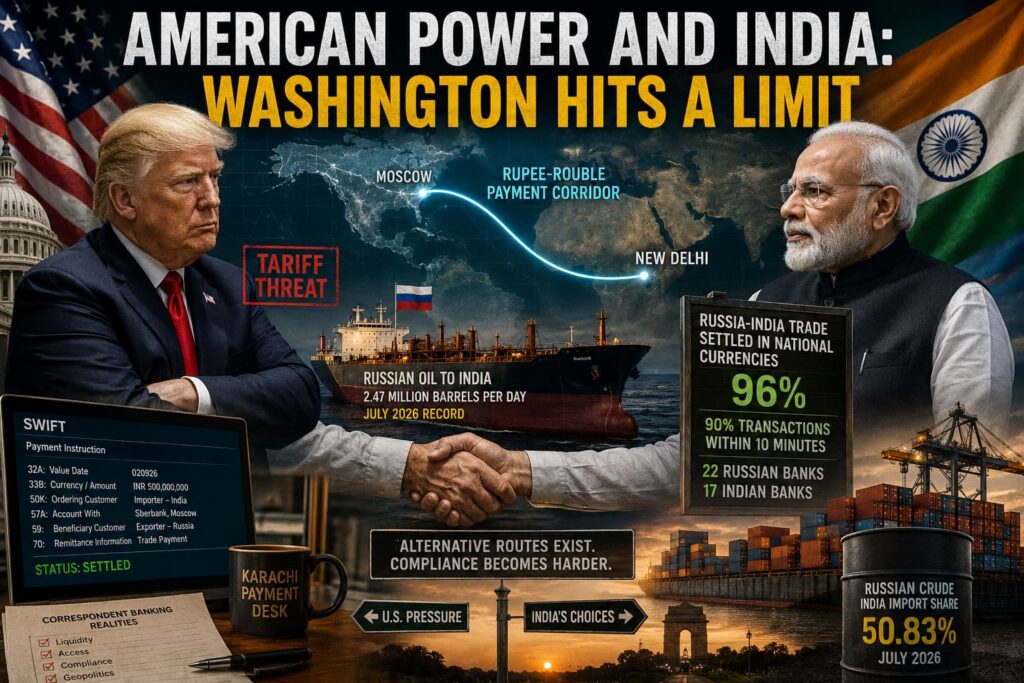
At a SWIFT desk on I. I. Chundrigar Road, one currency field can expose more geopolitics than a summit speech. I watch payment instructions move through correspondent chains, and I know how quickly political power becomes a question of access. American Power and India now sits inside that question. Sberbank says 96 percent of Russia-India trade settles in rupees and roubles, while most transactions finish within minutes. (reuters.com)
A harder fact followed in August. Russian crude supplied 50.83 percent of India’s oil imports in July 2026, equal to 2.47 million barrels a day. Washington had already used tariffs to push New Delhi away from Russian oil. India made a political commitment, but later market conditions and energy needs reopened the Russian route. (reuters.com)
My argument is narrower than the fashionable claim that America has lost global power. Washington still commands exceptional financial reach. Yet India exposes a limit: American coercion becomes less reliable when the target country has alternatives and the United States also needs the relationship.
American Power and India: A Payment Desk Test
Washington imposed an extra 25 percent tariff on Indian goods in August 2025 because India imported Russian oil. President Donald Trump removed that penalty on February 6, 2026 after India committed to stop direct or indirect purchases of Russian Federation oil. Monitoring remained explicit. His order told officials to watch for resumed Russian oil imports and consider restoring the tariff. (whitehouse.gov)
Then the oil returned. Indian refiners bought Russian crude at record scale in July as disruption in Middle Eastern supplies tightened alternatives and affected pricing. Commercial need did not erase American pressure, but it changed the cost of compliance. Reuters reported that Russia remained India’s largest crude supplier during April to July. (reuters.com)
Banking adapted quickly. Sberbank’s India chief says 22 Russian banks and 17 Indian banks now service bilateral trade across a corridor Moscow considers mature. He also says 90 percent of transactions finish within ten minutes. A network that once struggled with trapped rupee balances now appears to operate with far less friction. (reuters.com)
Nosov’s figures remain Sberbank’s account of the corridor, not an independent audit of Russia-India settlement flows. Fast settlement proves that the mechanism can work at scale. It does not prove that every participant enjoys the same liquidity or convertibility outside the bilateral system.
| Indicator | Latest figure | Why I read it as important |
|---|---|---|
| Russia-India trade settled in national currencies | 96% | Sberbank says dollar settlement is no longer necessary for most bilateral flows. (reuters.com) |
| Russian share of Indian crude imports, July 2026 | 50.83% | U.S. pressure did not remove Russian oil from India’s energy mix. (reuters.com) |
| U.S.-India goods and services trade, 2025 | $239.6 billion | Washington also has a large commercial stake in keeping India engaged. (ustr.gov) |
| U.S. dollar share of global FX reserves, 2026 Q1 | 57.13% | Dollar power remains far larger than any bilateral bypass suggests. (data.imf.org) |
| European Allies and Canada defence spending growth, 2025 | nearly 20% real increase | Europe is rearming inside a security system still centred on NATO. (nato.int) |
The table strips away both easy stories. America remains powerful. India also remains deeply tied to the dollar system outside the Russian corridor.
The change appears in the bargaining margin, where New Delhi can accept a cost today and reopen an option tomorrow. American pressure still hurts. Durable compliance has become harder.
Coercion Runs Through Institutions
Financial power works best when a state controls a network other countries cannot easily avoid. Dollar clearing provides one channel. Access to the American market provides another. American sanctions can therefore impose heavy costs without a naval blockade or a formal diplomatic rupture.
India has spent years reducing exposure at selected points. The Reserve Bank of India allows authorised banks to settle international trade through Special Rupee Vostro Accounts. Indian importers can pay rupees into a foreign correspondent bank’s account, while Indian exporters receive rupees from balances held there. RBI rules also allow surplus balances to fund permitted investments and current-account transactions. (rbi.org.in)
Messaging and settlement still need careful separation. A trade invoice can use rupees even when a bank relies on familiar communications standards. Currency choice does not automatically prove a complete exit from Western financial infrastructure. From a payment desk, I treat claims about “de-dollarisation” with caution because the currency field reveals only one layer of the transaction.
Yet the operational gain remains real. A Russian exporter that can receive value without first demanding dollars has fewer points of direct exposure to dollar clearing. An Indian importer gains another settlement option when ordinary channels become costly. Routine then begins to replace improvisation.
What a Karachi Payment Desk Reveals
I see the issue differently from I. I. Chundrigar Road because Pakistan lives with foreign-exchange scarcity in a way large reserve holders do not. A Pakistani importer can receive a valid invoice and still face a hard question: which currency can the bank actually fund at an acceptable spread? The payment instruction comes after the balance-of-payments problem, not before it.
India carries much more room for error. Reuters reported record foreign-exchange reserves of about $729 billion by late August 2026 after large foreign-currency inflows strengthened the Reserve Bank of India’s position. The same inflows created future forward liabilities, so the cushion is not free. Still, scale gives New Delhi room that Pakistan lacks. (reuters.com)
The deficit survives. Pakistan could settle more Chinese trade in yuan, but someone still has to earn the yuan or obtain it through another financing channel. Russia encountered a related problem when oil sales created excess rupee balances that could not easily leave India. Better recycling rules reduce friction, yet accounting cannot manufacture balanced trade.
Karachi makes the lesson physical. A country with thin reserves usually negotiates under intense time pressure and a narrow funding window. India can carry larger external shocks and keep bargaining. Strategic autonomy sounds like diplomatic doctrine in New Delhi; on a banking screen, it begins with liquidity.
Europe and India Do Not Face the Same America
Europe differs. NATO members agreed at The Hague in 2025 to move toward defence and security spending equal to 5 percent of GDP by 2035. European Allies and Canada then raised core defence spending by nearly 20 percent in real terms during 2025. (nato.int)
Higher European spending proves agency, not obedience. European governments can refuse Washington, and the European Union can threaten retaliation. Yet their choices operate inside an alliance where American military capacity has shaped deterrence for generations. NATO Secretary General Mark Rutte acknowledged in March 2026 that European Allies and Canada had relied too heavily on U.S. military power. (nato.int)
Trade exposed a different form of asymmetry. In July 2025, the EU accepted a 15 percent U.S. tariff framework after Trump had threatened 30 percent. Reuters described European negotiators as concluding that the bloc had more to lose from a full confrontation, while the EU also pledged large investment in the United States. (reuters.com)
Security dependence did not mechanically determine that trade deal. Europe had its own commercial calculations. Yet defence dependence forms part of a wider relationship in which Europe carries more institutional exposure to Washington than India does.
India stands in another institutional position. New Delhi never placed national defence inside an American alliance. It buys U.S. goods and values access to the American market, but it also retains Russian energy ties. Washington therefore confronts a partner that can resist without triggering an alliance crisis.
The commercial relationship cuts both ways. U.S. goods and services trade with India reached an estimated $239.6 billion in 2025. The White House’s February 2026 framework also linked lower U.S. tariffs with wider Indian market access and a stated Indian intention to purchase large volumes of American products over five years. (ustr.gov)
Coercion becomes harder when punishment damages a relationship Washington wants to expand. China magnifies the constraint because American strategy values a strong India in Asia. No secret motive needs to be invented. The public trade framework and defence cooperation already show that Washington has interests beyond Russian oil.
Dollar Power Has Not Disappeared
A rupee-rouble corridor can sound revolutionary when viewed alone. IMF reserve data impose discipline on the claim. The U.S. dollar accounted for 57.13 percent of disclosed global foreign-exchange reserves in the first quarter of 2026, up from 56.42 percent in the previous quarter after valuation effects. (data.imf.org)
India itself still manages enormous dollar liquidity exposure. Reuters reported that India attracted more than $127 billion through a special foreign-currency deposit scheme, while related inflows strengthened reserve management. Much of the flow entered through swaps with the central bank. (reuters.com)
No contradiction exists. States can bypass the dollar in selected corridors while still holding dollars for reserve management. Local settlement reduces one vulnerability but does not replace the liquidity of global dollar markets.
American decline therefore looks uneven. Washington can still raise the cost of a transaction and alter corporate behaviour. A major state with large reserves can sometimes absorb the shock long enough to build another route.
The Pressure Point Trump Cannot Easily Close
Trump’s India policy already contains the tension. His administration used a 25 percent tariff to punish Russian oil purchases, then removed the tariff after receiving an Indian commitment to stop. The February order explicitly kept the threat of reimposition alive. (whitehouse.gov)
Oil then returned at record scale. Sberbank now says local-currency settlement handles 96 percent of Russia-India trade. Neither development proves that American power failed everywhere. Both developments show that compliance can decay when commercial conditions change and alternative infrastructure matures. (reuters.com)
Europe troubles me more. America’s alliance partners often face high costs when they resist American preferences. India preserves more room because no treaty places its security under an American umbrella.
The next test will appear in a tariff schedule or an oil cargo, then in the settlement instruction that follows. Washington can raise the price of Indian defiance. New Delhi can keep asking how much strategic damage America will accept to collect that price.
A payment desk leaves the question open. If more major states learn to keep trade moving after American pressure arrives, the United States will still possess enormous financial power. The harder problem will sit one line lower on the ledger: how often can Washington turn power into durable obedience?