Germany wants tighter control over immigration while its ageing labour force increasingly depends on foreign workers. My daughter’s life in Munich makes that contradiction less abstract.
A Karachi Conversation That Led Me to Munich
I remember sitting in a busy Karachi café when Germany entered the conversation. Cups knocked against saucers, people talked across crowded tables, and the smell of chai hung in the room. A friend brought up the Alternative für Deutschland, the AfD, and the argument quickly moved from borders to a harder question: what does Germany do with foreigners who have already integrated into German life?
I kept thinking about the difference between immigration as a political issue and an immigrant as an actual person. The AfD demands a radical change in migration policy, yet its own 2025 election programme acknowledges that many immigrants have successfully integrated. It also places considerable weight on learning German and accepting Germany’s constitutional and legal order.
The subject is personal for me. My daughter lives in Munich with her husband and young son. When German politicians debate foreign workers and integration, I do not hear only an argument taking place thousands of kilometres from Karachi.
I think about my family.
The contradiction I see is not simply between Germans who welcome immigration and Germans who oppose it. Germany increasingly relies on foreign workers while one of its major political forces wants a much more restrictive migration system. The real question is whether those two realities can coexist.
The AfD Position Is More Complicated Than “No Foreigners”
It is tempting to reduce the AfD’s position to a slogan: foreigners out.
That description misses important distinctions.
The party’s 2025 federal election programme calls for strict limits on immigration and a fundamental reversal of German migration policy. Its programme also uses the term “remigration” for measures that include removing people legally required to leave Germany and encouraging voluntary returns.
Yet the programme itself recognises successful integration among some immigrants. It demands German-language acquisition and acceptance of the country’s constitutional order as central conditions for integration.
That distinction matters.
A serious examination of the AfD should therefore not start from the assumption that the party treats every foreign worker, asylum seeker and settled immigrant as the same political problem. Its model is far more restrictive than Germany’s current migration framework, but the dispute is also about selection, integration and how much immigration Germany should accept.
The harder test comes when that political preference meets demography.
Germany Cannot Manufacture Young Workers
Germany is getting older. Workers retire, while smaller younger generations enter the labour market behind them.
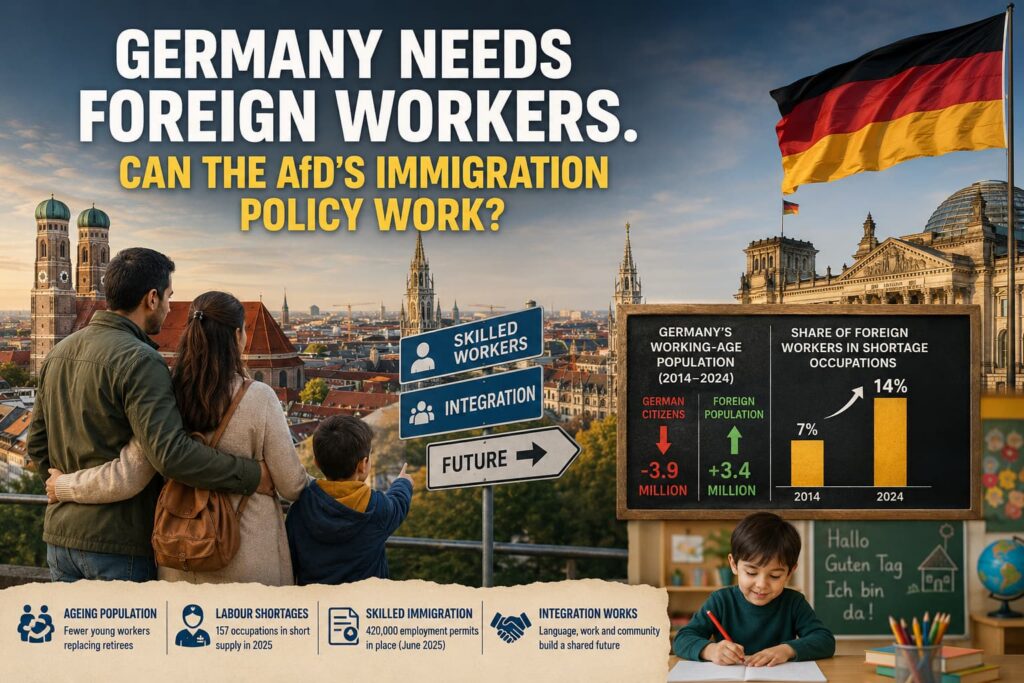
The Federal Employment Agency put the consequences plainly in July 2026. It reported that employment growth since 2024 had come exclusively from foreign workers. Between 2014 and 2024, Germany’s working-age population of German citizens fell by about 3.9 million, while the foreign working-age population increased by roughly 3.4 million.
Foreign workers have also become more important in occupations where Germany struggles to find staff. Their share of employees in shortage occupations doubled from about 7% in 2014 to roughly 14%.
The pattern is especially visible in some essential services. Nearly one in five people working in German nursing now has a foreign nationality, according to the Federal Employment Agency.
Germany can restrict immigration. It can demand stronger language skills and become more selective about whom it admits for employment.
What it cannot do is legislate millions of younger Germans into existence.
Higher birth rates would not solve today’s shortage either. A baby born in Germany this year will not replace a retiring nurse, technician or skilled tradesman next year. Demography moves slowly; employers experience vacancies now.
Yet another number complicates the story.
If Germany Needs Workers, Why Are Three Million People Unemployed?
Germany had 3.007 million registered unemployed people in July 2026. The unemployment rate stood at 6.4%, while the Federal Employment Agency described labour demand as weak. At the same time, employers had registered 653,000 vacancies with the agency.
At first sight, those figures seem incompatible.
If three million people are looking for work, why should Germany bring workers from abroad?
The answer lies partly in labour-market mismatch. An unemployed person does not automatically possess the qualifications required for a nursing position or another specialised vacancy. A worker may also live hundreds of kilometres from the available job. Training takes time, and employers cannot instantly convert unemployed workers from one occupation into qualified staff for another.
Germany therefore does not face a simple nationwide shortage of human beings.
It faces shortages of particular skills in particular places while other parts of its economy remain weak. That distinction strengthens one part of the AfD argument: Germany should make better use of people already living in the country.
But it also exposes the limit of that argument.
Domestic labour cannot fill every vacancy merely because unemployment exists. Qualifications, experience and location still matter.
The Federal Employment Agency’s own numbers show how far foreign workers have already entered that gap. Immigration is no longer a theoretical answer to some future demographic problem. It is part of Germany’s present labour market.
My Daughter’s Life in Munich Changed How I See Integration
Germany’s immigration debate is not entirely abstract to me. My daughter lives in Munich with her husband and their young son. She learned German and has made friends at work and among her neighbours.
My son-in-law has developed friendships of his own. They work, raise their child and have settled into ordinary life there. They are doing fine.
Their son is experiencing Germany differently from either parent. He has started learning German at Kita. At an age when words such as migration and national identity mean nothing to him, German is simply becoming one of the languages of his childhood.
[Place family photograph here]
My daughter with her husband and son. Their everyday life in Germany gives me a personal view of integration beyond the political argument over immigration.
When I look at photographs of them together, I see something political language can easily flatten into a category called “foreigners.” I see a young family going about ordinary life. Work, neighbours and a child at Kita rarely appear in the dramatic language surrounding Europe’s immigration debate.
Their experience does not prove that immigration always succeeds.
Some people integrate quickly; others struggle. Germany has legitimate questions about irregular migration, pressure on public institutions and social cohesion. One family’s experience cannot answer them.
It can show what successful integration looks like at street level.
Language matters. Employment matters too. Then come the smaller human connections that governments cannot manufacture: colleagues becoming friends, conversations with neighbours and children acquiring German naturally through Kita.
For me, that distinction has become difficult to ignore.
Germany Is Already Building a Foreign Labour System
Germany’s political argument becomes confused when asylum and labour migration are treated as if they were the same process.
They are not.
An asylum seeker arriving at the border raises questions about protection and immigration law. A qualified worker recruited for a German vacancy enters through a different legal route. EU citizens, meanwhile, operate under another framework through freedom of movement.
Germany has deliberately expanded its legal routes for foreign workers.
The Skilled Immigration Act took effect in March 2020. By June 2025, about 420,000 employees covered by social insurance held residence or settlement permits based on employment, compared with a little over 200,000 in 2020. More than half had entered through the EU Blue Card route.
The machinery continued to expand. The Federal Employment Agency issued more than 521,000 labour-market approvals in 2025, up 17% from the previous year. The agency cautions that approvals represent applications rather than individual people and do not necessarily result in entry to Germany, an important qualification when using the number.
I find that institutional development more revealing than political rhetoric.
Germany can argue fiercely about immigration while its labour-market institutions continue processing foreign workers because employers need people. The bureaucracy tells us something the slogans sometimes conceal.
Foreign labour has become structural.
Can Germany Depend on Immigration While Politically Rejecting It?
The AfD is right to raise one question that its opponents should not dismiss: how much more can Germany obtain from its existing workforce?
Training unemployed people makes economic sense. Encouraging greater labour participation can help. Automation will remove the need for some jobs and change others.
None offers an instant demographic escape.
A nurse retiring this year cannot wait for Germany’s birth rate to produce a replacement twenty years from now. An employer who needs a specialist today cannot assume that artificial intelligence will make the vacancy disappear next month.
The Federal Employment Agency says the number of German and EU employees is already declining and that workers from third countries are helping stabilise companies’ labour needs. Its conclusion is unusually direct: Germany needs labour migration if its labour market is to continue functioning.
That does not mean Germany needs unlimited immigration.
It means the real argument is about which migrants Germany needs, how many it can absorb, and what integration should require. Those questions are more difficult than either “open the borders” or “send the foreigners home.”
I keep returning to Munich when I think about them.
My daughter learned German and built a working life there. My son-in-law has formed his own relationships. Their son is now picking up German at Kita before he is old enough to understand why adults attach so much political meaning to the language he is learning.
Germany can tighten its borders. It can select foreign workers more carefully and expect people who settle there to integrate.
But Germany is already being changed by something slower than an election.
Demography.
Somewhere in Munich, my grandson is learning German words at Kita while adults argue about what Germany should become.
I am not sure politics has caught up with that child yet.