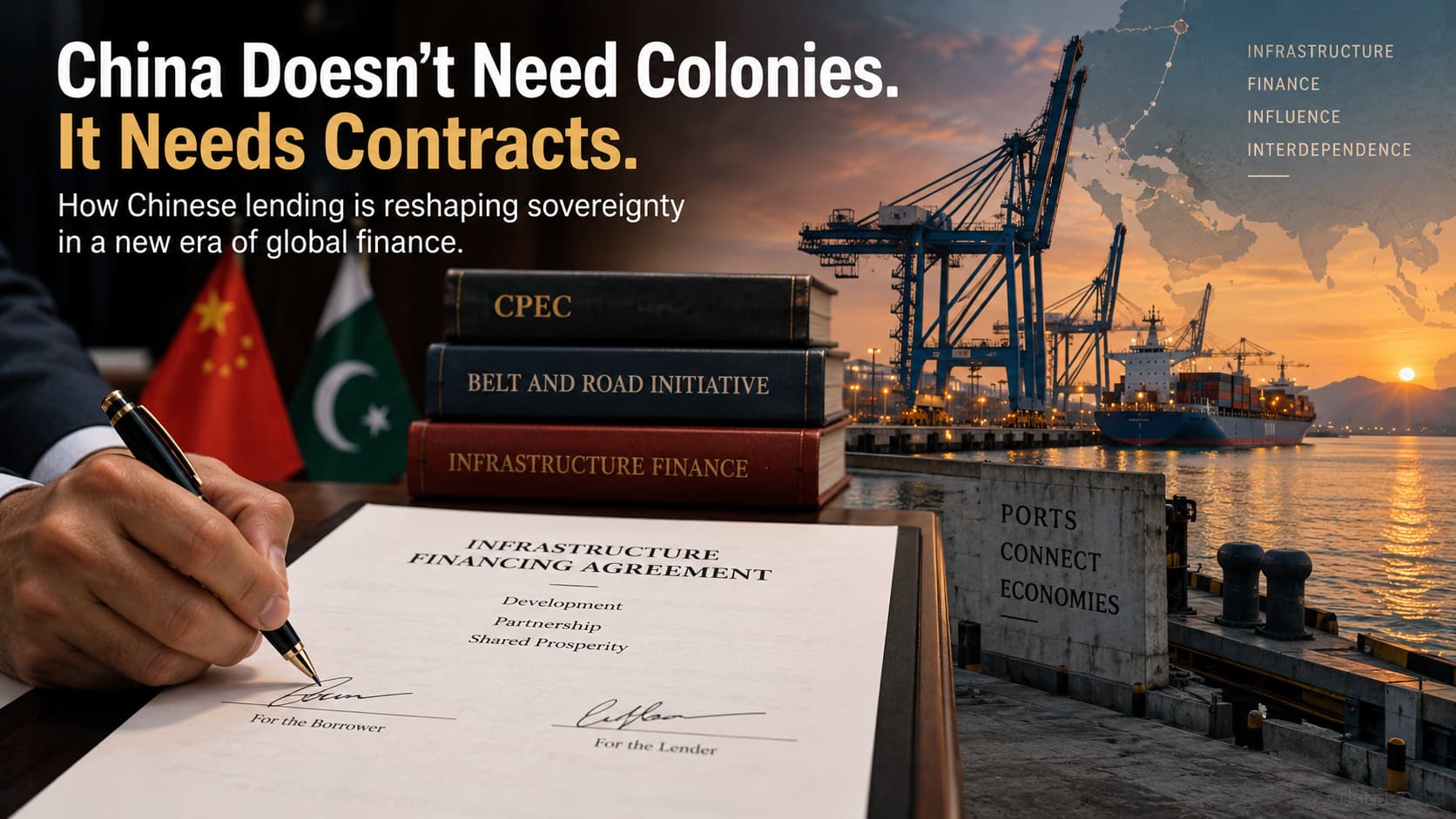
In Karachi, a foreign loan does not arrive looking like an empire. It appears in financing agreements and repayment schedules before the obligation eventually reaches the banking system. China doesn’t need colonies. It needs contracts. A government can retain its flag while discovering that financial dependence has reduced its freedom of action.
A reader recently described China’s overseas lending to me as a “neo-colonial empire with predatory debt.” I resist that description because it assumes an intention the evidence does not consistently establish. Researchers have not demonstrated a systematic Chinese strategy of deliberately bankrupting borrowers so Beijing can seize their assets.
The debt-trap debate therefore asks the wrong question. I am less interested in whether China intended to create dependency when a loan was signed than in what happens after a borrower needs the creditor more than the creditor needs the borrower. Intent is not required for financial dependence to produce political power.
China Doesn’t Need Colonies. It Needs Contracts.
China has become a major international creditor, but even its scale requires careful description. AidData’s 2025 global dataset tracks 33,580 projects across 217 countries supported by Chinese official-sector loans and grants worth nearly $2.2 trillion between 2000 and 2023. The figure measures cumulative financial commitments, not $2.2 trillion of debt currently owed to Beijing. (aiddata.org)
The composition also challenges the popular image of Chinese finance. AidData reports that Belt and Road infrastructure lending in developing countries represents only about 20 percent of the overall portfolio it tracks. Chinese official finance now extends deeply into richer economies as well. (aiddata.org)
Contracts reveal more than the headline number. Researchers examined 371 debt contracts between 20 Chinese state-owned creditors and 155 borrowers across 60 countries. A separate AidData study identified 620 collateralised public or publicly guaranteed loan commitments worth $418 billion across 57 lower-income economies between 2000 and 2021. (aiddata.org)
| Chinese overseas finance evidence | Finding |
|---|---|
| Official-sector loans and grants tracked, 2000 to 2023 | Nearly $2.2tn in commitments |
| Projects and activities tracked | 33,580 |
| Collateralised PPG loan commitments | $418bn |
| Collateralised transactions identified | 620 |
Collateral does not prove colonial intent. Banks and state lenders protect themselves against default because repayment risk exists. The political question begins when those protections affect revenues a distressed government needs for other purposes.
AidData found that foreign-currency revenues secure about 80 percent of the collateralised lending volume in its dataset. A typical arrangement can require export proceeds to enter restricted accounts, often at banks in China, where contractual rights protect repayment. (aiddata.org)
The mechanism matters more than the slogan. A commodity exporter earns foreign currency and routes agreed revenues into an offshore account. The creditor receives repayment protection while the borrowing government has less discretion over that money during financial stress.
In low-income commodity exporters covered by the research, balances held in those arrangements averaged more than 20 percent of annual public debt service owed to all external creditors. A contract written to reduce credit risk can therefore acquire political importance without turning the borrower into a colony. (aiddata.org)
Hambantota Shows Why the Easy Story Fails
Sri Lanka’s Hambantota Port remains the favourite example of alleged Chinese debt-trap diplomacy. The familiar story runs cleanly: Beijing financed an unwanted port and waited for Sri Lanka to fail before taking control through a 99-year lease.
The documented history is considerably messier.
Sri Lankan political leaders pursued the port project. Chatham House found that domestic political decisions drove Hambantota, while Sri Lanka’s wider debt problems involved borrowing from international capital markets alongside deeper weaknesses in economic management. China did not simply impose the project on Colombo. (chathamhouse.org)
Nor did Beijing cancel Hambantota’s construction debt in exchange for the port. China Merchants Port Holdings agreed in 2017 to invest about $1.1 billion under a long lease arrangement, while the original Chinese loans remained obligations of Sri Lanka. The transaction supplied foreign currency at a time when Colombo faced wider financial pressure. (chathamhouse.org)
The harder question begins after the myth ends.
A Chinese company still acquired a commercial position lasting generations in infrastructure located near major Indian Ocean shipping routes. Rejecting the claim that Beijing deliberately trapped Sri Lanka does not require pretending that a 99-year commercial relationship lacks geopolitical significance.
Borrower agency matters too. Sri Lankan officials chose the project and later negotiated the lease. Any analysis that turns developing countries into helpless objects of Chinese strategy reproduces an oddly colonial assumption of its own.
Contracts Create Power, Not Omnipotence
Borrowers can push back.
Malaysia demonstrated that point after Mahathir Mohamad returned to office in 2018. His government suspended the China-backed East Coast Rail Link and reopened negotiations over its cost. Kuala Lumpur later reached revised terms and restarted the project.
The episode matters because China did not dictate every outcome. A borrower with political resolve and credible alternatives could renegotiate a major Belt and Road project. Contracts created bargaining positions without eliminating Malaysia’s capacity to bargain.
Institutional strength therefore changes the relationship.
A government with stronger negotiating capacity can demand new terms when a project becomes unacceptable. A government facing depleted reserves and few financing alternatives enters the same conversation from a weaker position.
The distinction prevents my argument from becoming deterministic. Chinese lending does not automatically create dependency, and dependency does not automatically produce Chinese control. Financial power grows when the borrower lacks realistic alternatives.
From Karachi, Sovereignty Meets the Payment Date
Pakistan makes that distinction difficult for me to treat as theory. CPEC brought electricity generation and transport infrastructure into an economy that needed investment. Chinese finance also became part of a much wider structure of external obligations.
Reducing Pakistan’s debt problem to Beijing would be absurd. Pakistan has borrowed from multilateral institutions and international markets, while repeated balance-of-payments crises long predate CPEC. Domestic fiscal weakness remains central to the story.
The operational pressure appears when foreign currency becomes scarce.
External debt service does not disappear because reserves have fallen. Governments then seek refinancing or rollovers from creditors whose cooperation can become increasingly important. Sovereignty sounds abstract until dollars become scarce.
I see the issue differently because of my work around cross-border payments. A political announcement can describe a loan as friendship or strategic partnership, but the banking system eventually encounters an amount and a value date. Financial obligations retain their arithmetic after diplomatic language has faded.
Pakistan’s recurring need for external financing demonstrates the mechanism. Bilateral deposits and rollovers can support foreign-exchange reserves during periods of stress, giving creditor relationships significance beyond the original infrastructure project.
A government need not receive a political instruction for creditor power to matter. Officials already know which financing relationships they cannot afford to lose.
Creditor Power Is Not a Chinese Invention
China did not invent sovereign financial dependence. Western creditors have exercised power through debt for generations.
IMF programmes can attach economic conditions to financial support. Commercial bond contracts can restrict borrowers through legal covenants, while sovereign restructurings expose governments to creditor bargaining power.
The difference lies less in discovering creditor power than in the institutional form China has developed. Chinese state-linked lenders frequently combine infrastructure finance with contractual repayment protections outside the traditional Paris Club framework.
Calling those protections colonial would still go too far. Creditors have legitimate reasons to seek repayment, especially when lending large sums to governments with weak finances. Chinese lenders have learned to protect themselves against risks that conventional sovereign lending often leaves unsecured.
Yet contractual protection can change the distribution of pain during a crisis.
If export earnings enter a lender-protected account, the creditor has stronger access to repayment while unsecured creditors compete for what remains. Government spending can also face pressure when foreign currency becomes scarce.
AidData’s collateral research explicitly raises concerns about fiscal autonomy and debt transparency. The researchers do not need a theory of colonial conquest to identify those consequences. (aiddata.org)
The question therefore becomes narrower and harder: when does ordinary creditor protection begin to restrict sovereign economic choice?
Empire Has Never Required a Governor Everywhere
Direct colonial rule offers an imperfect historical comparison. European empires sometimes governed territory formally, but imperial influence also operated through concessions and creditor relationships in states that retained nominal sovereignty.
China’s contemporary overseas finance should not be equated casually with those arrangements. Borrowing governments negotiate agreements because they want capital, while Chinese lenders generally operate through contracts with recognised sovereign states.
The historical comparison still exposes something important. Legal sovereignty and material freedom have never meant exactly the same thing.
A state may possess complete international recognition while facing severe economic constraints on what its government can actually choose. Financial dependence can narrow those choices without changing a border.
Modern contracts can therefore produce influence without reproducing colonial administration.
The lender does not need to select ministers or occupy a customs house. Influence can arise because repayment rights endure through changes of government while the borrower continues to need financing.
China’s system also extends well beyond poor Belt and Road borrowers. AidData found that the share of its lending portfolio supporting high-income and upper-middle-income countries had risen sharply, reinforcing the point that Chinese state finance cannot be reduced to a simple poor-country debt-trap model. (aiddata.org)
The architecture is financial before it becomes political.
The Signature Remains
Someone still signs the agreement.
Borrowing governments choose projects and accept repayment obligations, even when political incentives encourage bad decisions. Chinese lenders cannot bear responsibility for every fiscal failure that follows.
Consent at signing does not freeze the balance of power for twenty years.
A government can negotiate voluntarily and remain legally sovereign throughout the life of a loan. Yet the relationship changes when reserves fall and refinancing becomes urgent because the creditor controls money the government cannot easily replace.
From Karachi, I know what remains after speeches about friendship have ended. Payment dates do not respond to political language, and foreign-exchange shortages can turn yesterday’s financing partner into today’s indispensable creditor.
The flag still flies above the government building.
The contract still has a maturity date.
- AI Transparency Statement: “This analysis was drafted under editorial direction with AI technical assistance, then verified and edited by Munaeem Jamal.”