In June 2023, 45,000 tonnes of Russian crude reached Karachi under Pakistan’s first government-to-government oil deal with Moscow. Pakistan paid in Chinese renminbi rather than dollars. I remember why the settlement detail caught my attention: the Russia Pakistan Freight Corridor now under discussion asks a much larger version of the same question. Can Pakistan’s geography acquire economic value for Moscow without displacing India’s far deeper relationship with Russia?
For most of my life, the geopolitical map looked simpler. Moscow stood close to Delhi, while Pakistan remained tied much more closely to Washington. A Russian visitor now lives in Pakistan, speaks Urdu and describes the country with an ease that would have sounded unusual during the old relationship.
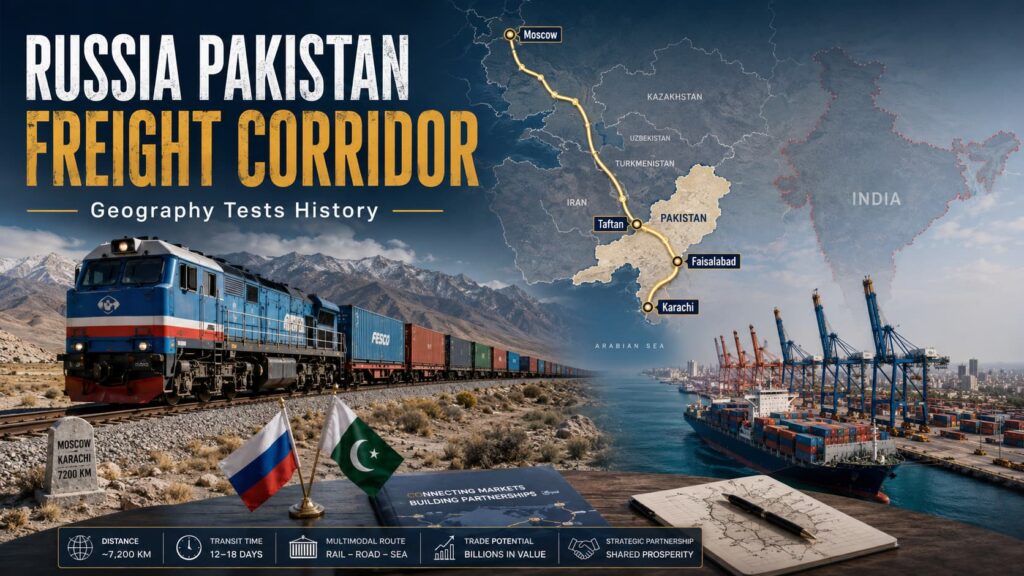
The railway story makes his personal experience harder to dismiss as an isolated curiosity. Russian officials are now discussing freight trains running toward Faisalabad and Karachi. India still owns most of the historical relationship, but Pakistan may be acquiring something different: a route.
Russia Pakistan Freight Corridor: What Is Actually Moving
Russian Ambassador Albert Khorev gave the important detail on 8 August 2026. Moscow and Islamabad are working on their first freight railway services along the Moscow-Faisalabad and Moscow-Karachi corridors in both directions. Belarus may join later.
The project remains unfinished.
Khorev said regional tensions during 2025 and early 2026 delayed implementation several times. Officials are still finalising the freight-services contract and identifying companies willing to use the route. A functioning commercial corridor therefore does not yet exist.
Pakistan has already started preparing part of the southern infrastructure. The government declared Taftan Railway Station a customs-clearance point in 2026, while Pakistan Railways identified ML-3 as the principal rail link toward Iran. Officials expect work on its upgrade to begin during the current fiscal year and target completion by December 2029.
A physical problem sits at the border.
Pakistan uses 1,676 mm broad gauge, while Iran uses 1,435 mm standard gauge. Freight therefore faces a gauge break around Taftan and Mirjaveh, which means cargo handling or bogie changes can add time and cost. Regional corridor maps look clean on paper; railway engineering rarely does.
| Indicator | Evidence | What I read from it |
|---|---|---|
| First Pakistan government Russian crude deal | 100,000 tonnes contracted in 2023 | Energy trade became operational, not merely diplomatic |
| Cargo initially landed at Karachi | 45,000 tonnes | Karachi already served as the physical entry point |
| Pakistan-Russia trade, FY2023-24 | About $963 million | Relationship remained economically modest |
| Pakistan imports from Russia, FY2023-24 | About $880 million | Trade leaned heavily toward Russian supply |
| Indian Russian crude share, July 2026 | 50.83% of India’s crude imports | India’s economic relationship with Russia operates on another scale |
| Proposed rail services, August 2026 | Moscow-Faisalabad and Moscow-Karachi | Russia now sees Pakistan partly through connectivity |
Pakistan’s Commerce Ministry put bilateral trade at roughly $963 million in FY2023-24, with Pakistani exports of only $83 million. Officials specifically identified banking hurdles as a major constraint.
Numbers like those matter.
A railway can move containers, but it cannot by itself solve settlement risk. Banks still need acceptable currencies and compliant counterparties. Sanctions screening can turn a politically attractive trade route into an operational headache long before a wagon reaches Taftan.
India Owns the History
I grew up with another Russia.
The Soviet Union maintained a strategic relationship with India that Pakistan never matched. Pakistan instead entered Western security arrangements and later became a frontline state against Soviet forces in Afghanistan. Episodes of Soviet economic cooperation existed, including Pakistan Steel Mills, but no comparable political intimacy emerged.
Liaquat Ali Khan sits near the beginning of that memory.
Pakistanis often repeat a simple story: Moscow invited Liaquat, he ignored Russia and went to America. The record carries more texture. Liaquat accepted the Soviet invitation in 1949, yet the Moscow visit never materialised; he then travelled to the United States in May 1950.
I still think the outcome mattered more than the argument over blame.
Pakistan increasingly entered the American strategic orbit. Moscow moved closer to India. By the time later generations inherited the relationship, Russia hardly looked like Pakistan’s natural great-power partner.
The Russian guest from the earlier interview belongs to another period. His university education introduced him to Pakistan before his first visit in 2019, and direct experience made his favourable opinion stronger. He even decided to connect his future with Russia-Pakistan relations.
One man cannot rewrite seventy years.
Yet his presence tells me something about the social distance that has begun to shrink. The freight corridor tells me something harder: institutions are also testing a relationship that history kept shallow.
Karachi Gives Moscow Something Different
Karachi changes the calculation because geography does not remember the Cold War.
The city sits on the Arabian Sea with established port infrastructure and a national rail network reaching northward. Moscow does not need Karachi to replace Mumbai or another Indian port. Russia needs options.
The transcript makes that distinction repeatedly.
Its narrator begins with a sensational claim that Russia has left India for Pakistan, then later corrects the framing. The deeper argument concerns logistics: Moscow wants additional land routes toward the Indian Ocean while reducing exposure to disrupted maritime pathways.
Karachi becomes valuable inside that logic.
A Russian freight train reaching Pakistan could connect Russian cargo with a southern maritime outlet. Pakistan gains the opposite possibility: exporters could send goods north toward Russia and Eurasian markets without relying entirely on long sea routes.
From my cross-border payments perspective, I see another layer.
Physical connectivity and financial connectivity rarely advance at the same speed. A train may cross Iran after customs clearance, while the payment behind its cargo still has to survive correspondent-bank controls. Russian sanctions exposure makes that distinction sharper.
Pakistan has already experimented with an alternative settlement mechanism. The 2023 Russian crude purchase used renminbi, a notable departure from Pakistan’s usual dollar-centred oil payments.
One transaction did not create a new monetary order.
It did show what commercial pressure can do. When traditional settlement channels become difficult, trade either finds another mechanism or fails to move.
Oil Exposes the Unequal Relationship
India remains the uncomfortable comparison.
Pakistan did buy Russian crude. Constraints at its ports and refineries, combined with foreign-exchange pressure, prevented the trade from reaching the scale once imagined. Reuters reported in 2023 that Pakistan was unlikely to achieve its target of sourcing two-thirds of crude imports from Russia.
India moved in the opposite direction.
Russian crude accounted for a record 50.83 percent of India’s oil imports in July 2026, equal to 2.47 million barrels per day. Imports from Russia rose 62.4 percent from a year earlier despite continuing American pressure around Russian energy purchases.
The contrast is brutal.
India has the refining system and market size to turn Russian energy into a structural economic relationship. Pakistan conducted a meaningful experiment, but infrastructure and foreign-exchange limits kept it small.
Moscow knows the difference.
Russian engagement with Pakistan therefore does not mean India has lost Russia. Indian Foreign Minister S. Jaishankar told Vladimir Putin in August 2026 that economic cooperation between India and Russia had grown significantly.
Pakistan offers another proposition.
India buys Russian oil at massive scale. Pakistan can offer transit geography and perhaps a southern outlet. One relationship does not mechanically cancel the other.
A Corridor Is Not a Friendship Treaty
I would resist the emotional language surrounding the project.
Pakistan often reads foreign investment as proof of strategic affection. Great powers usually operate with colder arithmetic. A railway survives when cargo volumes cover costs and payments clear reliably.
Russia’s own ambassador used operational language.
Contracts still need completion. Companies still need identification. The project has already suffered postponements.
Pakistan also carries infrastructure debt.
The Quetta-Taftan section requires rehabilitation, while ML-3 needs a major upgrade. Gauge differences add handling friction at the Iranian border. Even customs reform at Taftan solves only one piece of the chain.
A corridor therefore becomes valuable only when cargo moves repeatedly.
Pakistan’s government has promoted a larger connectivity ambition linking the country with Central Asia and Russia. Moscow has also discussed Pakistan as a possible transit hub.
Commercial reality will decide how much of that language survives.
The strongest signal may come from somewhere less dramatic than a presidential meeting. A freight forwarder signing a recurring contract would tell me more. So would a bank finding a compliant settlement route that works month after month.
The Route Still Has to Work
I return to the Russian guest because his story now feels different.
He encountered Pakistan first through study and later through streets, language and ordinary people. His visit to Balochistan challenged the image he had encountered abroad, although his personal experience cannot serve as a current security assessment.
Russian planners are discovering another Pakistan.
Their version appears on freight maps. Karachi looks like a port, while Taftan becomes a border junction. Pakistan’s value shifts from ideological alignment toward physical access.
History still points toward India.
July’s oil figures make that impossible to ignore. India’s Russian relationship carries enormous commercial weight, and decades of strategic familiarity sit behind it. Pakistan cannot erase either fact with one proposed train.
Geography keeps interrupting history, though.
Moscow now wants route diversity at a moment when sanctions and maritime disruption make redundancy more valuable. Pakistan happens to sit where part of that search can reach the Arabian Sea.
The train has not proved anything yet.
Contracts can fail. Rail infrastructure can delay cargo, while settlement restrictions can stop a trade flow without touching a single track.
I can already see the question from Karachi.
India has Russia’s history. Pakistan may get part of Russia’s route. Whether that route becomes regular commerce will depend on what happens after the speeches end and the first invoice arrives.
SEO & Blogger Indexing Package
- Focus Keyphrase: Russia Pakistan Freight Corridor
- SEO Title (H1): Russia Pakistan Freight Corridor: Geography Tests History
- Subtitle: India owns decades of Russian strategic history, while Pakistan may offer Moscow a new route toward the Arabian Sea.
- Custom Blogger Permalink: russia-pakistan-freight-corridor-geography-history.html
- Blogger Search Description: Russia Pakistan Freight Corridor gives Moscow a possible Arabian Sea route without replacing India’s deeper Russian ties.
- Taxonomy Labels: Russia-Pakistan Relations, India-Russia Relations, Karachi Port, Eurasian Connectivity
Social Syndication & Engagement Assets
- LinkedIn / Professional Snippet: A Russian crude cargo reached Karachi in 2023, and Pakistan paid in renminbi. Three years later, Moscow is discussing freight trains to Faisalabad and Karachi. I do not see Russia abandoning India. I see geography giving Pakistan a role that history denied it. Can that route survive the banking and infrastructure friction that comes after diplomacy?
- Topic Hashtags: #RussiaPakistan #IndiaRussia #Geopolitics #MunaeemJamal
- AI Transparency Statement: “This analysis was drafted under editorial direction with AI technical assistance, then verified and edited by Munaeem Jamal.”