A message reached my phone in Karachi this morning while I was following the latest developments around the Persian Gulf. Raja Saad Khan was writing about an American defeat against Iran, but one part made me stop: he believed discussion inside the United States about tactical nuclear weapons showed how badly conventional American power had failed. I did not accept that causal link, yet the message pointed towards a harder question that has followed me since.
I checked the nuclear claim first. In June, the U.S. Senate Armed Services Committee recommended authorization for two new nonstrategic nuclear weapons even though the Defense and Energy departments had not requested funding for them. The timing matters because Congress did not suddenly discover tactical nuclear weapons after Iran resisted American conventional force; the debate already existed, and treating it as proof of an imminent nuclear attack on Iran would turn analysis into alarm.
Something else bothered me more. What happens when the United States can destroy an opponent’s military infrastructure but still cannot force that opponent to accept Washington’s political terms? I have watched American power from this side of the Arabian Sea for decades, and the distinction now looks less academic than it once did.
Karachi changes the view. The Persian Gulf is not a distant patch on a Pentagon operations map when ships leaving this coast move towards those waters and Pakistani households depend heavily on Gulf economies. An oil shock travels surprisingly fast from a narrow strait to the illuminated price board above a Karachi petrol pump, which is where grand strategy suddenly loses its grandness.
Foundation: America Built More Than a Military
American power after 1945 did not rest simply on the ability to drop more bombs than an adversary. Washington built an overseas military system that allowed it to move enormous force close to a crisis and keep that force supplied until political pressure began to work. Independent researchers still estimate that the United States maintains hundreds of military installations overseas, with commonly cited estimates running to roughly 750 sites across about 80 countries.
The political purpose of that architecture matters more than its size. An aircraft carrier moving towards a coastline could alter calculations before its aircraft launched, because leaders in the targeted country knew what normally followed American concentration of force. Military capability created political pressure.
Vietnam exposed a crack in the arrangement. American forces possessed immense firepower, yet North Vietnam continued absorbing punishment that American planners expected would alter Hanoi’s political calculations; Saigon finally fell on 30 April 1975 after years of war that had demonstrated the distance between destroying targets and controlling an adversary’s decisions. The United States suffered humiliation, but its worldwide military architecture survived.
Afghanistan produced another warning. Washington entered Kabul after the attacks of September 2001 and left twenty years later as the Taliban returned to power, while desperate scenes at Kabul airport supplied the withdrawal with images that statistics could never soften. American aircraft could still reach almost anywhere on earth after August 2021, so the machinery of power remained formidable even though the political project had collapsed.
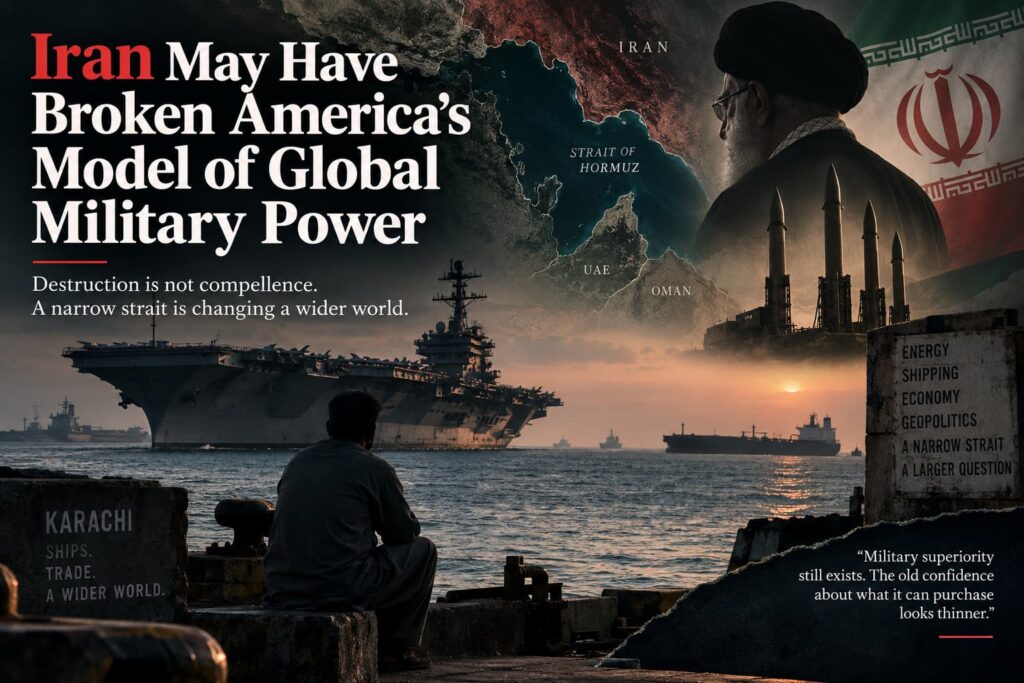
Iran presents a different kind of problem because its geography works directly against concentrated military power. A narrow waterway sits beside Iranian territory, while American facilities across the Gulf operate within reach of increasingly capable missiles. Technology has made distance shorter for the defender too, and that change cuts into an old American advantage.
Analysis: Destruction Is Not Compellence
I do not believe Iran must sink an American aircraft carrier to change the strategic equation. Tehran needs to make concentrated American power costly enough that Washington struggles to convert military superiority into political obedience, especially when Iran can continue imposing economic pain without matching America weapon for weapon. A missile that forces dispersal can matter even if television viewers never see a burning ship.
The Strait of Hormuz shows the mechanism. Before the current conflict, close to one-fifth of global petroleum liquids consumption moved through the strait, making this narrow passage one of the world’s most important energy arteries. By 20 August, ship-tracking data recorded only seven commodity vessels crossing during the day, and Reuters reported that neither a very large crude carrier nor an LNG tanker appeared among them.
I read those figures in Karachi and stopped at the number seven. Shipping statistics normally look dull on a screen, particularly to anyone outside trade or banking, but seven vessels through a waterway of such importance tells a story that missile counts cannot capture. Captains and insurers start making strategic decisions long before politicians admit that deterrence has changed.
I know this machinery from another end. Cross-border commerce eventually arrives inside banks as payment instructions, settlement requirements and compliance work, while behind each sterile transaction sits a physical shipment that somebody must insure and somebody must risk moving through the sea. When shipping hesitates, finance feels the hesitation later, stripped of smoke and noise but carrying the same economic damage.
Iran has grasped a principle that weaker states have used for centuries. It does not need symmetrical strength if it can attack the mechanism through which the stronger state converts military capacity into influence. Reuters reported earlier in August that Tehran was using pressure on shipping and energy flows to raise the economic cost of confrontation for Washington.
Aircraft carriers remain extraordinarily powerful warships. Calling them “sitting ducks” goes too far, because carrier groups possess layered defences and mobility that a fixed land target lacks. Yet missiles can force commanders to devote more resources to protection, while drones create another defensive burden at costs that often favour the attacker.
American superiority therefore survives while its political yield becomes less certain. Washington can impose a blockade and send aircraft over immense distances, but Tehran can exploit geography while refusing the settlement America wants. The stronger state then faces an unpleasant problem: adding force may increase destruction without increasing obedience.
Political scientist Thomas Schelling gave me the language for understanding the distinction. In his work on coercion, Schelling separated brute force from the use of threatened pain to influence an adversary’s choices; destroying something and compelling somebody are different political acts. A government may possess an extraordinary capacity to hurt another state yet discover that the punishment no longer buys the decision it wants.
The difference changes how I read American military statistics. Counting aircraft answers what Washington can strike, while counting warships tells me how much force it can bring to the theatre. Neither figure answers whether Iran will obey.
Compellence succeeds only when pain changes behaviour. If Tehran absorbs enormous damage and still refuses Washington’s political terms, American forces can win individual engagements while the American state fails at the point where military violence must become a political result. I think critics who answer this argument by listing American weapons are answering the wrong question.
A superpower can destroy far more than its opponent and still fail to compel it. Iran does not have to defeat the United States to expose a failure in the American model of power. Survival becomes strategically important when the stronger country’s objective requires the weaker country to stop resisting.
Washington’s present behaviour makes the distinction harder to ignore. Defense Secretary Pete Hegseth has said the United States can maintain its naval blockade, while the administration has also intensified economic pressure against Tehran. Treasury Secretary Scott Bessent announced another major sanctions push on 20 August and presented economic pressure as part of Washington’s effort to force Iranian concessions without another major military expansion.
I find the return to economic coercion revealing because America possesses overwhelming conventional military capacity already. If months of military operations still leave Washington searching for additional economic leverage, destruction has not settled the political contest. Iran continues to attach conditions to reopening Hormuz, and normal commercial traffic has not returned.
A faint smell of diesel near Karachi’s port makes the argument less theoretical for me. Containers move, cranes turn slowly against the sky, and the ordinary machinery of commerce looks almost stubbornly boring until a waterway hundreds of kilometres west begins closing. One blocked artery can make all that routine movement more expensive.
The old American system grew during decades when Washington could place expensive military assets close to weaker opponents and expect technological superiority to protect the concentration. Precision missiles have damaged part of that assumption, while cheap drones have increased the cost of defence. Geography was waiting there all along.
The Nuclear Question Is a Symptom, Not Yet the Story
Nuclear weapons enter the argument at an uncomfortable point. Congressional interest in new nonstrategic nuclear capabilities does not establish an American intention to use them against Iran, and the June Senate proposal cannot honestly serve as evidence that Washington reached for nuclear options after conventional operations failed. I would damage the article’s central argument if I pretended otherwise.
Yet renewed attention to regional nuclear options deserves scrutiny. An August assessment of the forthcoming American nuclear strategy discussed the administration’s interest in more flexible nuclear capabilities, though the strategic discussion extends well beyond Iran and includes major-power deterrence. The important issue for me is not whether an American bomb is about to fall; no credible public evidence establishes that.
The dangerous question begins earlier. What does a nuclear-armed superpower do when enormous conventional superiority inflicts damage but fails to produce compliance? Military bureaucracies keep options because leaders dislike discovering during a crisis that the option they suddenly want does not exist.
The word “tactical” makes nuclear weapons sound almost manageable. It suggests a battlefield tool with a boundary around it, although any nuclear detonation in war would cross a threshold no country has crossed since the United States bombed Nagasaki on 9 August 1945. Former U.S. Defense Secretary James Mattis told Congress that he did not believe any such thing as a tactical nuclear weapon existed because any nuclear weapon used at any time represented a strategic game changer.
The vocabulary becomes cleaner as the consequences become dirtier. Hiroshima had hospitals too, and Nagasaki had families eating breakfast before a weapon turned an argument about military necessity into something humanity has spent eighty-one years refusing to repeat. “Tactical” cannot keep the radioactive boundary conveniently inside a battlefield map.
Unresolved Close
I keep returning to Hormuz because ships provide a colder measurement of power than speeches. Washington can say it possesses control, while Tehran can issue its own declarations; commercial traffic supplies another kind of evidence when captains decide whether the passage is safe enough to enter. By 20 August, the number crossing remained brutally small.
From Karachi, I can almost draw the line west across the Arabian Sea. America remains vastly stronger than Iran by every conventional military measure that normally appears in comparative tables, yet strength and political control have stopped looking like synonyms in this war. I do not think Washington has solved that contradiction.
For decades, the silhouette of an American carrier approaching a crisis zone carried a political message before the first aircraft left its deck. The ships remain formidable, but I am no longer certain that the message produces the same reaction from a state prepared to absorb punishment and keep fighting. Military superiority still exists; the old confidence about what it can purchase looks thinner.
Out beyond Karachi’s coast, the Arabian Sea looks deceptively ordinary. Tankers continue towards waters where destructive capacity and political control no longer fit comfortably inside the same sentence, while Washington still has levels of force it has never used. I do not know what happens when a superpower decides that accepting the limits of its power costs more than testing the next limit.