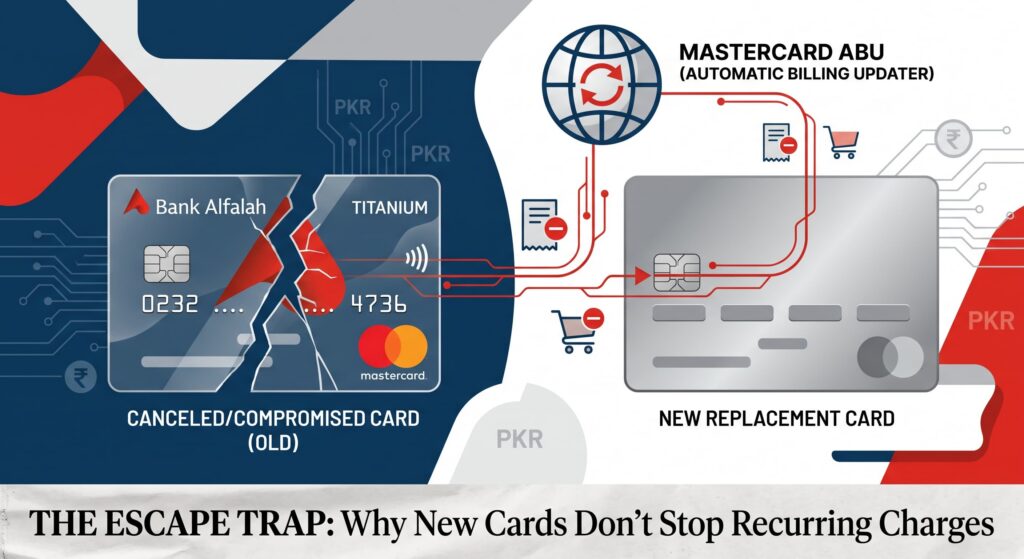
I checked my banking app at breakfast and froze. Two weeks earlier, I canceled my compromised credit card following an unauthorized recurring debit from an obscure foreign merchant. Bank Alfalah issued a fresh piece of plastic. The replacement carried a new 16-digit number, a new CVV, and an updated expiry date. I assumed the financial link to that rogue vendor was dead. Yet a brand-new charge hit my unactivated card before I used it once for online shopping.
Cardholders in Pakistan assume that canceling a card stops subscription drains. You report the unauthorized debit, pay the replacement fee, and receive fresh plastic. The threat feels gone.
Behind banking networks lies an automated protocol called the Mastercard Automatic Billing Updater (ABU). Visa runs a matching tool called Visa Account Updater (VAU). Developed to keep Netflix or Spotify running when a card expires, these tools push your new payment details directly to registered global merchants.
ABU offers convenience for valid subscriptions. When applied to gray-market merchants or forced auto-debits, it creates an inescapable loop.
Corporate Refusal: How Local Banks Mislead Customers
I called the bank to ask how an unauthorized merchant accessed a brand-new card number. The agent recited a familiar script:
“Sir, international merchants process transactions automatically through the network, and we cannot block specific international vendors.”
Call center agents misstate the rules. Payment networks like Mastercard give issuing banks direct access to MasterCom and card-level configuration portals. Bank staff can use these systems to opt specific primary account numbers (PANs) out of ABU entirely. They can also place hard network-level merchant blocks.
Pakistani banks avoid this step because operating these portals requires manual compliance work. It also demands specialized back-office routing to scheme managers. Bank operations teams prefer pushing the burden back onto you. They tell you to contact the merchant directly, even when that merchant operates out of an offshore tax haven.
The Regulatory Shield: What the State Bank of Pakistan Mandates
Pakistani consumers have clear regulatory backing. The State Bank of Pakistan (SBP) enforces strict rules regarding digital payment channels, consumer consent, and liability for unauthorized debits. Commercial banks rely on customer ignorance regarding three specific directives:
| SBP Regulation | Core Mandate | Practical Protection |
| PSD Circular No. 09 (2018) | Mandatory Channel Controls | You hold the legal right to toggle online and cross-border channels off instantly. |
| BPRD Circular No. 04 (2023) | Fraud Liability Framework | The bank bears financial liability if unauthorized debits continue after formal written notice. |
| Consumer Protection Framework | Fair Treatment Rules | Banks must process opt-out requests for network tools that override cardholder intent. |
Under SBP PSD Circular No. 09 of 2018, financial institutions must grant you full operational control over digital channels. Exporting new card tokens to a merchant after you canceled your previous card directly violates this mandate.
Under SBP BPRD Circular No. 04 of 2023, sending written notice of an unauthorized debit shifts the legal burden to the institution. If the bank ignores your request to opt out of Mastercard ABU and the merchant charges your new card, the bank must credit those funds back to your account.
The Action Plan: How to Permanently Cut Off Rogue Merchants
Hotline calls rarely stop automated billing loops. You need a formal paper trail:
- Email the Complaint Management Unit: Write directly to your bank’s formal CMU. Demand an immediate opt-out of the Mastercard Automatic Billing Updater (ABU) system for your account, alongside a permanent merchant block for the specific vendor.
- Lock Digital Channels via Mobile Banking: Open your bank’s mobile app and disable e-commerce and international payment channels. This setting prevents tokenized settlements from clearing while your complaint sits in queue.
- Demand a Hard Product Closure: If the bank claims it cannot disable ABU, demand a full product closure without token migration. Force the bank to issue an unlinked, fresh product application.
- Escalate to the Banking Mohtasib: If the bank fails to process your ABU opt-out within 45 days, file a formal complaint with the Banking Mohtasib Pakistan citing service deficiency under the Banking Companies Ordinance, 1962.
When commercial banks treat ABU as an unalterable default, convenience turns into financial liability. SBP directives give you the leverage to challenge this practice, provided you skip the hotline and force the bank’s compliance unit to act in writing.